President El-Sisi Witnesses Wheat Harvest Season Activities 2026
alhadath – cairo
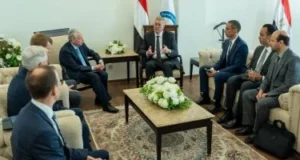
Today, President Abdel Fattah El-Sisi witnessed the inauguration of the New Delta project on the Sheikh Zayed Axis in Giza, formerly Dabaa Axis.
Upon his arrival, the President was received by Prime Minister Dr. Moustafa Madbouly, Deputy Prime Minister for Economic Affairs Dr. Hussein Issa, Commander- in-Chief of the Armed Forces and Minister of Defense and Military Production Lieutenant General Ashraf Salem Zaher, Chief of Staff of the Armed Forces Lieutenant General Ahmed Khalifa, Governor of the Central Bank of Egypt Mr. Hassan Abdullah, Minister of Transport Lieutenant General Eng. Kamel El-Wazir, Minister of Water Resources and Irrigation Dr. Hani Sewilam, Minister of Supply and Internal Trade Dr. Sherif Farouk, Minister of Agriculture and Land Reclamation Alaa Farouk, and Executive Director of the Future of Egypt Authority for Sustainable Development Colonel Bahaa El-Ghannam.
The Spokesman for the Presidency, Ambassador Mohamed El-Shennawy, said the event started with a recitation of verses from the Holy Quran, followed by the screening of a documentary film entitled “The New Delta.” Executive Director of the Future of Egypt Authority for Sustainable Development Colonel Bahaa El-Ghannam also delivered a speech that included the inauguration of Water Pumping Station No. (3) Naba’ via video conference.
President El-Sisi pointed out that what had been achieved in the New Delta Project would not have been possible except by the grace of Allah the Almighty and through the efforts of the Egyptian people. The President urged the Egyptian people to feel proud of what had been accomplished within the framework of this project. The President further noted the major challenges that had been overcome in order to implement it.
President El-Sisi also emphasized that the project reflects the combined efforts of all state institutions, alongside active participation from the private sector, with 150 companies working in agricultural production, in addition to hundreds of companies involved in other activities.
Regarding the scope of the work executed within the project, the President stated that the project’s cost had reached nearly EGP 800 billion, with a cost ranging between EGP 350,000 and 400,000 per feddan, in addition to the construction of new roads totaling 12,000 kilometers in length.
In the same context, President El-Sisi referred to the challenge of providing the water required for the project by collecting agricultural drainage water from lands of the Delta governorates, after subjecting it to tertiary treatment. This was followed by establishing and lining two routes: the Northern Route and the Eastern Route, each extending 150 kilometers.
The President highlighted that transporting the collected water was done against the natural geographical slope of the land, which required the construction of 19 main pumping stations to provide water for cultivating 2.2 million feddans. He also noted the construction of power stations with a total capacity of approximately 2,000 megawatts.
President El-Sisi reiterated that the strategic vision for the project, as well as for developing the productivity of the agricultural sector in Egypt, is based on achieving integration between old and new agricultural lands. Under this vision, traditional crops such as wheat and corn would be produced in the clay soils of the Valley and Delta because of their higher productivity, while the new lands would focus on crops that achieve high quality in desert soils, such as sugar beet, thereby maximizing the benefit from the land and crop cycles.
The President also mentioned that the project provides around two million job opportunities, emphasizing that these are sustainable rather than temporary jobs. He further highlighted the important role of the private sector in the project, explaining that cultivation is carried out by private companies with agreements on target crops according to the adopted crop rotation system.
President El-Sisi also underscored the difficulty of achieving self-sufficiency in all crops, whether in Egypt or in most countries around the world, because agricultural production depends on several climatic, water-related, and environmental considerations. The President noted that Egypt imports between 14 and 17 million tons of feed annually, in addition to wheat imports. In this context, the President stressed that achieving development is an ongoing process that never ends, and that ambition likewise has no limits, including in efforts to maximize agricultural production. He referred to other projects currently being implemented in Minya, Beni Suef, Kom Ombo, Toshka, East Oweinat, and Sinai.
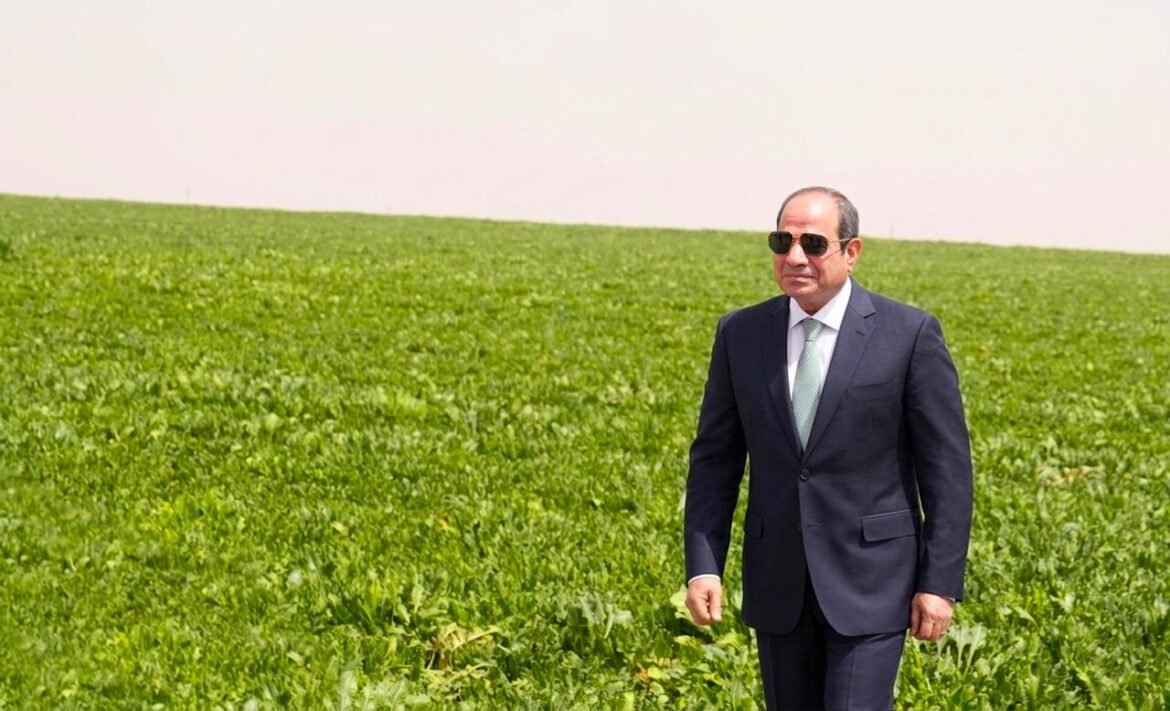
President El-Sisi then conducted an inspection tour, including Pumping Station No. (3) Naba’ and a model of the industrial works and “operation and control system,” before proceeding to the wheat harvesting site. The President listened to a detailed explanation about the productivity of wheat per feddan and the quality of the crop. Then, the President participated in a commemorative photo with the project workers and some attendees.
The President concluded his inspection tour by observing the productivity of the sugar beet crop.
 +00000000